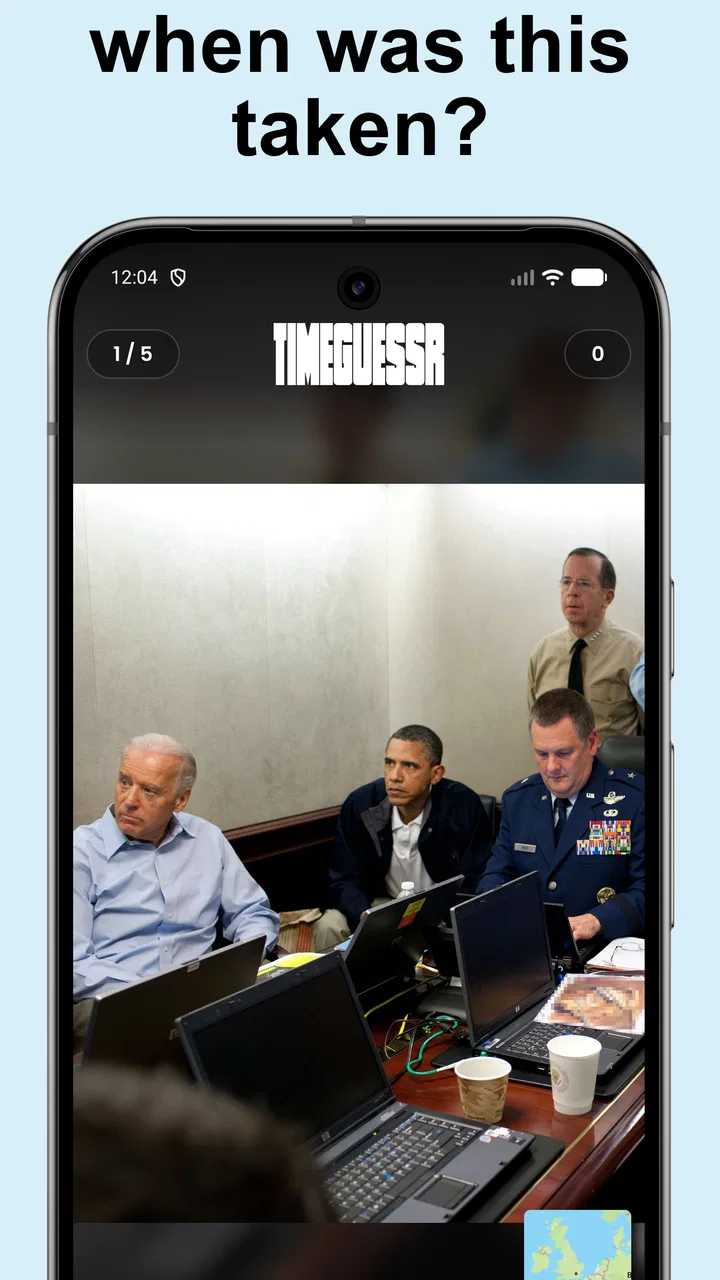
TimeGuessr
- 4.9
- Rating
- 50.00K
- Installs
- Free
- Price

 Analysis by App-foxy
I went into TimeGuessr expecting a familiar map quiz, but it quickly showed a more interesting personality. This is a free trivia game from TimeGuessr that asks me to connect places with periods in history, rather than relying on geography alone. A good answer often comes from noticing several small clues at once: the setting, the architecture, the vehicles, the clothing, the image quality, and the general feeling of a particular era.
That combination makes each round feel different from a standard capital-cities quiz. I am not simply trying to remember whether a city belongs to one country or another. I am estimating where a scene could be and when it might have been captured. The result is a game that rewards curiosity, visual memory, and sensible deduction more than fast tapping.
The game is listed as suitable for Everyone, which fits the straightforward presentation and educational subject matter. It is free to play, and its average rating sits at 4.9 from around 2.3 thousand ratings, with more than 50 thousand installs. Those figures suggest that it has found a committed audience, but the real question is whether its particular blend of history and geography matches the way you like to play.
You May Also Like

 AccuWeather: Weather Radar
AccuWeather Review: A Quick, Clear Forecast for Everyday Decisions
For everyday plans, the best forecast is the one you can understand quickly. AccuWeather makes rain timing, radar, and local conditions easy to act on, with a few trade-offs.

 Hill Climb Racing
Why Hill Climb Racing Still Turns Crashes Into One More Run
A tiny car, a bumpy hill and one more upgrade: Hill Climb Racing keeps resurfacing because its simple chaos makes every near-miss feel personal.

 AliExpress - Shopping App
AliExpress Makes Global Shopping Feel Personal, but Shoppers Bear the Risk
AliExpress turns a global marketplace into a pocket-sized discovery engine. Its reach is useful, its shopping loop compelling, and its trade-offs easy to miss.

 Lords Mobile: Kingdom Wars
Lords Mobile Is a Kingdom-Building Routine, Not a Quick Match
A case-by-case verdict on the building, battles, device demands, and social commitments that make Lords Mobile rewarding for some players and exhausting for others.

 PDF Scanner app - TapScanner
TapScanner Makes Paperwork Easier to Capture, Check, and Share
TapScanner makes scanning with a phone feel less like a rescue operation and more like a dependable step in getting work done. Its capture tools are useful, though not flawless.

 Block Blast!
 Shows How Much a Puzzle Game Can Leave Out
A quiet grid game shows why puzzle players increasingly value instant clarity, repeatable skill and low-pressure play—and where the genre still needs to catch up.
More From Our News Desk
View All News


How I built a reliable TimeGuessr routine
I built a reliable routine by separating observation from guessing: first I scan the scene for broad geographic clues, then I look for details that might place it in time, and only then do I commit. That keeps one striking feature from steering the whole answer. Next, I turn that routine into a quick review habit so each round teaches me something, even when my estimate is off.
The basic round is about collecting clues before guessing
My first useful change was to stop treating every image as a single visual question. Instead, I began with a short scan. I looked for road markings, signs, buildings, public transport, landscape, and anything that could indicate an era. Only after that did I form a location guess. This sounds simple, but it prevents the most common mistake: committing to a country because of one familiar-looking object.
The historical side changes the rhythm. A scene may look geographically recognizable while still belonging to a very different period from the one I initially assumed. Older cars, street furniture, storefront design, construction styles, and image quality can all shift the answer. I found it more useful to ask, “What details would still be here today?” and “Which details suggest an earlier moment?” than to chase one dramatic clue.
For a casual session, I would play a few rounds without trying to maximize every result. That gives enough time to notice how the game presents its challenges and whether you enjoy the uncertainty. When I played with friends, the best discussions came after a difficult image, when we compared why one person trusted the architecture while another trusted the traffic clues.
A practical everyday scenario is a short break between tasks. I can play a round, make a reasoned estimate, and move on without needing the long setup of a traditional strategy game. It also works well as a shared activity: one person can focus on geography while another studies historical details. That division of attention makes the game more social than its simple format might suggest.
Why the usual alternatives feel different
Compared with a conventional trivia app, this game gives me less value from memorizing isolated facts. Knowing the capital of a country helps, but it does not solve an image where the real challenge is identifying a region from visual context. Compared with a pure map-guessing game, the historical layer makes familiar places less predictable. A modern-looking city and an older photograph of the same kind of city may demand completely different reasoning.
That is also the main trade-off. Players who want quick questions with definite answers may find the visual deduction slower and more subjective. I enjoy the ambiguity, but I would not choose this as my first recommendation for someone who prefers rapid-fire quizzes, word puzzles, or clearly stated factual questions.
Settings and habits worth checking before serious play
I would begin by checking the device’s sound and display settings before blaming the game for a poor session. Visual trivia depends on seeing small details, and a dim screen or aggressive battery-saving mode can make signs and distant objects harder to inspect. Headphones are not essential for the core challenge, but a quiet environment helps me concentrate on the image instead of rushing through it.
The game runs on Android devices using version 7.0 or later. That makes it accessible to a broad range of phones, although the experience still depends on the individual screen. On a smaller display, I found myself zooming mentally rather than physically, so rotating the phone or increasing system text size may not help every visual element. A larger screen is more comfortable when several clues appear far apart in one scene.
I also recommend deciding in advance whether you are playing for learning or for score. Those are different sessions. For learning, I pause after an uncertain result and explain the clue to myself. For score, I use a short decision window and accept that some guesses will be imperfect. Mixing both goals can become frustrating because careful investigation naturally takes longer.
One useful habit is to keep a simple mental record of recurring mistakes. I noticed that I was more likely to overvalue architecture than road design, so I deliberately checked signs and traffic patterns before finalizing a guess. Another player might make the opposite error. The important point is to identify your personal bias rather than assuming every miss comes from a lack of knowledge.
Faster patterns that improve decisions without pretending to know everything
Experienced play is not about recognizing every location instantly. It is about narrowing the possibilities in a repeatable order. I usually start with the broad environment: dense city, small town, countryside, coast, or mountainous area. Then I inspect infrastructure, because roads, poles, signs, and public transport often reveal regional habits more reliably than decorative architecture.
After that, I look for time clues. Cars can be useful, but I avoid treating one vehicle as decisive. A single old car may simply be an exception. A group of vehicles, the style of storefronts, the condition of roads, and the appearance of public spaces together make a stronger case. The same principle applies to clothing: one person is weak evidence, while a broader scene can suggest a period more convincingly.
When I am uncertain between two places, I compare the explanations rather than searching for certainty. Which guess accounts for more visible details with fewer excuses? This is a valuable shortcut because it turns a vague impression into a small test. If my preferred location requires me to dismiss the road markings, the buildings, and the vehicles, it is probably an emotional guess rather than a good one.
I also learned to separate location confidence from time confidence. I might be fairly sure about the country but unsure about the decade, or I might recognize the historical atmosphere while having no strong regional clue. Keeping those judgments separate prevents one weak estimate from contaminating the other. It also makes the reveal more educational, because I can see exactly which part of my reasoning failed.
Using repeatable review sessions instead of random guessing
If you want to improve, do not judge yourself only by the final result. After a difficult round, identify the first clue you noticed, the clue you ignored, and the clue that would have been most useful. This three-step review takes less time than replaying every decision and gradually builds a personal checklist.
I find it helpful to alternate between relaxed and focused sessions. In a relaxed session, I follow curiosity and enjoy surprising locations. In a focused session, I force myself to inspect the same clue groups in the same order. The second approach is less spontaneous, but it reveals whether my improvement comes from real observation or from occasional lucky recognition.
Playing with another person creates another useful workflow. Before revealing an answer, each player should state both a location and a reason. “It feels European” is not enough; “the road layout and building style point in this direction” can be discussed and challenged. This turns the game into a compact lesson in evidence, and it exposes assumptions that are easy to miss when playing alone.
Where the game becomes difficult for advanced players
The deeper I went, the more I appreciated that the game does not make every image equally solvable from obvious clues. Some scenes are likely to remain uncertain even after careful inspection. That is not necessarily a flaw, but it changes the expected experience. The goal is often to make the best-supported estimate, not to produce a perfect answer from one unmistakable landmark.
This can create friction for players who need complete control. A person who dislikes ambiguous questions may feel that knowledge is being tested alongside interpretation and luck. I would skip this game if I wanted a study tool with a predictable syllabus, detailed explanations after every answer, or a clearly ordered progression from beginner to expert. Its appeal is closer to visual investigation than formal revision.
There is also a limit to how much faster a player can become. Once the obvious clues are exhausted, improvement depends on broader cultural and historical familiarity. That may encourage learning outside the game, but it also means that repetition alone will not solve every weakness. If you repeatedly miss because you cannot distinguish regional infrastructure, the answer is not simply to tap more quickly; it is to develop better visual reference points.
Another limitation is the possibility of overfitting to memorable images. If I see a similar street later, I may rush to reuse the previous answer even when the evidence is different. The best defense is to describe the current image in neutral terms before comparing it with memory. That small pause keeps recognition useful without letting it become a trap.
Who will get the most from it?
I think the strongest audience is anyone who enjoys geography but wants more context than borders and flags. History students may appreciate the visual prompts, while travelers can use the game to sharpen attention to streetscapes and regional details. It is also a good fit for families or friends looking for a discussion-based quiz that does not require specialist equipment.
It suits patient players better than purely competitive ones. The satisfaction comes from assembling clues, especially when the final answer is different from the first instinct. If your favorite part of trivia is debating evidence, this has more to offer than a standard multiple-choice format.
I would be more cautious about recommending it to someone who wants a fully explained learning course. The game can provoke questions, but it is not a replacement for a history textbook, atlas, or structured language-and-culture lesson. It is best used as a prompt for curiosity: after a surprising round, look up the place, period, or visual feature that caused confusion.
My verdict after testing the full workflow
TimeGuessr works because it turns two familiar subjects into one visual puzzle. Geography narrows the place, history narrows the moment, and the player has to decide which clues deserve trust. I like that it rewards observation without requiring every answer to be instantly recognizable.
The free price removes the biggest barrier to trying it, and the Everyone rating makes it easy to consider for mixed-age play. The developer, TimeGuessr, has kept the concept focused rather than burying it under unrelated game systems. Its current version is 1.1.14, and the game was released on May 11, 2025, so it feels like a relatively recent option for this kind of trivia.
My strongest advice is to play it with a method: scan broadly, separate place from period, compare competing explanations, and review the clue you ignored after each miss. That habit makes the experience more rewarding and reduces the temptation to guess from atmosphere alone.
This is a game for making informed estimates, not for pretending every image has an obvious answer. If you enjoy visual clues, historical context, and conversations about why a location looks the way it does, I would recommend giving it a try. If you prefer instant factual questions or a structured course with guaranteed explanations, another trivia format will probably serve you better.
FAQs for TimeGuessr
01What is TimeGuessr and how does it work?
TimeGuessr is an engaging trivia game that challenges players to identify historical events, places, or famous figures based on photos or clues. Players are tasked with guessing the correct year or era, earning points for accuracy. The app offers a fun way to test and expand your historical knowledge.
02Is TimeGuessr suitable for all age groups?
TimeGuessr is designed for a broad audience, making it suitable for both adults and older children. The game’s content is educational and family-friendly, with varying levels of difficulty to accommodate different knowledge levels. However, younger children might need assistance due to the complexity of some historical topics.
03Does TimeGuessr require an internet connection to play?
Yes, TimeGuessr requires an internet connection to download new content and updates, and to participate in online leaderboards and challenges. However, once the content is downloaded, some gameplay modes may be accessible offline, though features like multiplayer will remain unavailable without an internet connection.
04Are there any in-app purchases or ads in TimeGuessr?
TimeGuessr includes optional in-app purchases that allow users to unlock additional content or remove ads for an enhanced experience. Advertisements may appear between levels or as banners, but they are non-intrusive. Players can enjoy most of the game’s features without spending money, making it accessible to all.
05How can I track my progress in TimeGuessr?
TimeGuessr offers a detailed progress tracking system where players can view their scores, achievements, and historical accuracy over time. Players can compare their performance with friends or global players via leaderboards. The app also provides insights into areas of improvement, encouraging educational growth and competition.
Pros
- Engaging trivia challenges enhance learning.
- User-friendly interface is easy to navigate.
- Regular updates keep content fresh and fun.
- Multiplayer mode adds interactive competition.
- Offline play available for on-the-go fun.
Cons
- Limited categories may limit replay value.
- Ads can interrupt gameplay occasionally.
- Requires frequent internet for updates.
- Some questions may repeat over time.
- In-app purchases can be pricey.

TimeGuessr
Gallery